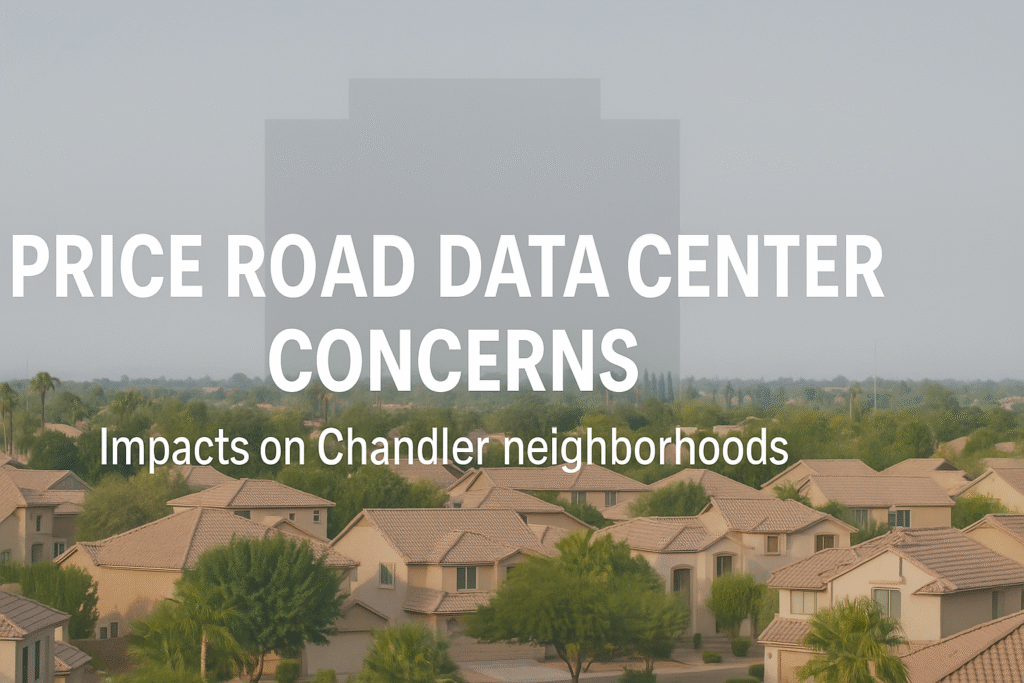
Price Road Data Center Concerns
The Price Road Data Center Concerns outlined on this page explain how the proposed project could affect nearby Chandler neighborhoods, including noise, rezoning impacts, and the potential for high-intensity computing uses such as crypto-mining.
Residents have raised multiple Price Road Data Center Concerns related to location, zoning, noise, and long-term neighborhood compatibility.
The following sections break down the key Price Road Data Center Concerns so Chandler residents can easily understand the major issues.
Table of Contents
The proposed Price Road Data Center raises several concerns for Chandler residents due to its location, potential noise, water usage, and compatibility with nearby homes. This page outlines the key issues behind the Price Road Data Center concerns and helps residents understand how the project could impact our neighborhoods before the upcoming City Council meeting.
A developer is requesting a major zoning change to convert the former Space Data / Orbital / Northrop Grumman campus at Price & Dobson into a 40-acre AI and industrial computing complex. Their own notice confirms that one of the new buildings—Building A—is planned as an AI data center.
If approved, this project would bring heavy-industrial technology uses less than 1,000 feet from Chandler homes. Once rezoned, the site could legally host almost any advanced computing operation, including:
- Large-scale AI model training
- High-density data processing and server farms
- Potential Crypto mining operations
Crypto mining in particular is known for extreme power consumption, continuous mechanical noise, and 24/7 operation. Combined with the possibility of multiple high-intensity tenants over time, this zoning change would permanently transform the character of this site from a traditional office/R&D campus into a round-the-clock industrial computing hub.
Once rezoned, the site could legally host any advanced computing operation, including large-scale data processing, AI model training, server farms, and even crypto-mining, which is known for noise, power intensity, and neighborhood impacts.
This is not the type of development Chandler residents were ever led to expect next to established neighborhoods.
One of the central Price Road Data Center Concerns is the lack of clarity around what level of computing activity the developer actually plans.
1. What the Developer Says They Want to Build
According to the developer’s August 18, 2025 community letter, the project includes:
- Six new buildings
- One building as a dedicated AI data center
- The rest as a “tech campus” for:
- Artificial intelligence
- Advanced computing
- Research & development
- Flex industrial
- Bioscience / healthcare
- Aviation / aerospace
- Information technology
They also describe the existing property as “functionally obsolete” and unable to attract tenants since 2019.
But the zoning request would enable far more intense uses—many of which were NOT mentioned in the letter.
2. What They Don’t Mention — The High-Intensity Risks
Data centers and heavy computing operations run 24 hours a day, seven days a week. Even with low occupancy, these facilities require continuous cooling, power conditioning, and mechanical equipment. This introduces:
- Constant low-frequency mechanical noise
- Heat output and waste thermal loads
- High energy consumption
- Potential for diesel generator testing
- Nighttime operational activity
- Traffic from service technicians and equipment deliveries
Most importantly, the requested zoning would not limit future tenants. Any advanced computing user—no matter how intense—could occupy the site.
3. Key Concerns With the Price Road Data Center Proposal
The scale and intensity of operations proposed are not compatible with nearby homes, parks, and lakes. Data centers generate noise regardless of occupancy and require large rooftop or ground-mounted cooling infrastructure.
This site sits next to open water, which is known to carry and amplify sound.
The massing and height of the buildings also raise concerns about visual impact, shade, property values, and long-term neighborhood character.
4. Potential Environmental and Energy Impacts
Data centers consume massive amounts of electricity, often equal to thousands of homes. Chandler would need to dedicate additional power capacity to support this project, potentially affecting reliability during peak demand periods.
Cooling systems may also require significant water use, especially in summer. In a region managing long-term water scarcity, placing a water-intensive industrial user next to residential lakes raises additional concerns about sustainability.
Many Price Road Data Center Concerns have come directly from Chandler homeowners who live closest to the proposed site.
5. Why Crypto Mining Is a Particular Risk at This Site
Crypto-mining operations are some of the loudest, most power-dense industrial computing uses in the world. Unlike traditional tech offices or R&D tenants, large crypto-mining rigs run at full power 24 hours a day and require constant cooling from high-speed fans and HVAC units. In cities across the country, crypto-mining sites have generated steady low-frequency noise, vibration, and bright nighttime lighting that disrupt surrounding neighborhoods.
If this zoning change is approved, nothing prevents a future tenant from operating a crypto-mining facility here, because the proposed zoning allows any advanced computing use. That means the heaviest, loudest, least community-friendly type of computing could end up less than 1,000 feet from Chandler homes, amplified across open water and directly adjacent to residential neighborhoods that were never intended to sit next to an industrial computing plant.
Crypto mining is not only disruptive — it is incompatible with the character and livability of the Ocotillo area.
6. Expected Noise Levels and Real-World Examples
Across Arizona and the Southwest, residents living near data centers have reported:
- Constant humming from cooling towers
- Vibration inside homes
- Noticeable nighttime noise due to lower ambient sound
- Difficulty sleeping near 24/7 equipment
Low-frequency sound—common with data center chillers—travels farther and penetrates walls more easily.
In other cities, noise studies have shown that even well-designed facilities can exceed residential limits when placed too close to homes.
No acoustical modeling or sound study has been presented for this site.
7. How This Project Differs From Other Data Centers
Chandler’s existing data centers were placed deep within the Price Road industrial corridor, far from homes, lakes, and parks. They were specifically sited where continuous mechanical noise and high-intensity operations would not disturb residential areas.
The proposed site is fundamentally different. It sits directly next to neighborhoods designed around quiet streets, water features, schools, and walking paths. No other Chandler data center has been approved this close to single-family homes, and none sit on lakefront property that naturally amplifies noise. This project would break long-standing siting practices that have protected nearby residents for decades.
8. What Residents Are Saying
Across Ocotillo, Fulton Ranch, and surrounding areas, residents share similar concerns:
- Loss of peace and quiet due to round-the-clock mechanical noise
- Sound amplification across the lakes
- Increased industrial traffic in a residential corridor
- Long-term effect on home values
- Incompatibility with Chandler’s family-oriented neighborhood design
Neighbors strongly support economic development — but not at the cost of community livability. A project of this scale and intensity simply does not belong next to established homes.
Additional Price Road Data Center Concerns relate to the unclear approval timeline and the limited information available prior to the vote.
9. Timeline: What Happens Next in the Approval Process
The project is moving through Chandler’s zoning and planning review process:
- City staff analysis and recommendation
- Planning & Zoning Commission review
- City Council vote scheduled for December 11, 2025
- Final approval or denial
Resident participation before the Council vote is essential. Once approved, the zoning allows future tenants and uses far more intense than what has been presented publicly.
10. How You Can Voice Your Concerns
Residents can directly influence the outcome by engaging in the process:
- Email each member of the Chandler City Council
- Attend the upcoming hearing and speak
- Submit comments to city planning staff
- Share this information with neighbors
- Join the Ocotillo Neighborhood Coalition for coordinated updates
Respectful, informed feedback matters — especially when many residents participate together.
11. Join the Ocotillo Neighborhood Coalition
The Ocotillo Neighborhood Coalition (ONC) is a non-partisan, resident-led group focused on protecting the character, safety, and livability of our neighborhoods.
Join us on Facebook to stay informed, get updates, and help shape the community response:
👉 Facebook Group: Ocotillo Neighborhood Coalition
https://www.facebook.com/share/g/14UBTkorWgt/
Together, we can advocate for responsible development that fits the character and expectations of our community.
Frequently Asked Questions (FAQ)
Is this project definitely a data center?
Yes. The developer’s own documents identify Building A as an AI data center. The requested zoning also allows additional high-intensity computing operations beyond what has been publicly described.
Could a crypto-mining operation occupy this site?
Yes. The proposed zoning permits almost any advanced computing use, including crypto mining, which is known for continuous noise, vibration, and extremely high power demand.
Why is this location different from Chandler’s existing data centers?
Chandler’s current data centers were placed deep inside industrial zones, far from homes, schools, parks, and water features. This site is directly adjacent to residential neighborhoods, where noise travels farther and the visual impact is unavoidable.
Has a noise study been conducted?
No public acoustical modeling has been released. Residents have formally asked for this analysis before any approval is granted.
How can residents influence the decision?
By emailing City Council members, participating in the upcoming public hearing, and submitting comments to city staff. Public involvement is a formal and influential part of Chandler’s review process.
For a full summary of the project, visit our Home Page Overview.
Take Action Today
This decision will shape our community for decades. Your voice matters — and the time to speak up is now.
- Join the Ocotillo Neighborhood Coalition on Facebook
- Share this page with neighbors and local groups
- Email the Chandler City Council before the December 11 vote
- Attend the City Council meeting and speak during the hearing
Responsible development requires responsible planning — and together, we can ensure our neighborhoods remain safe, livable, and protected.
Residents deserve clear, transparent information about the Price Road Data Center concerns before the December 11 vote.
Learn more about the impacts on local homes on our Impacts page.Impacts
See Chandler’s official zoning code here. https://www.chandleraz.gov/
By understanding these Price Road Data Center Concerns, residents are better equipped to make informed comments before the December 11 City Council meeting.